Easy Way to Remember How Hydrogen Wave Function Density Plots Look
8.ii: The Wavefunctions
- Folio ID
- 4528

The solutions to the hydrogen atom Schrödinger equation are functions that are products of a spherical harmonic part and a radial part.
\[ \psi _{n, l, m_l } (r, \theta , \varphi) = R_{n,l} (r) Y^{m_l}_l (\theta , \varphi) \characterization {viii-20}\]
The wavefunctions for the hydrogen atom depend upon the three variables r, \(\theta\), and \(\varphi \) and the three quantum numbers n, \(l\), and \(m_l\). The variables give the position of the electron relative to the proton in spherical coordinates. The accented square of the wavefunction, \(| \psi (r, \theta , \varphi )|^ii\), evaluated at \(r\), \(\theta \), and \(\varphi\) gives the probability density of finding the electron inside a differential volume \(d \tau\), centered at the position specified by r, \(\theta \), and \(\varphi\).
Exercise \(\PageIndex{1}\)
What is the value of the integral
\[ \int \limits _{\text{all space}} | \psi (r, \theta , \varphi )|^ii d \tau \, ? \nonumber\]
The quantum numbers have names: \(n\) is called the principal quantum number, \(l\) is chosen the angular momentum quantum number, and \(m_l\) is called the magnetic quantum number considering (as we will come across in Section viii.4) the energy in a magnetic field depends upon \(m_l\). Often \(50\) is called the azimuthal quantum number because it is a consequence of the \(\theta\)-equation, which involves the azimuthal angle \(\Theta \), referring to the angle to the zenith.
These quantum numbers have specific values that are dictated by the physical constraints or boundary conditions imposed upon the Schrödinger equation: \(due north\) must be an integer greater than 0, \(l\) can take the values 0 to n‑i, and \(m_l\) can take \(2l + 1\) values ranging from \(-l\) ‑ to \(+l\) in unit or integer steps. The values of the quantum number \(l\) usually are coded past a letter: s ways 0, p means 1, d means 2, f ways 3; the side by side codes go on alphabetically (east.grand., k means \(l = 4\)). The quantum numbers specify the quantization of physical quantities. The detached energies of different states of the hydrogen atom are given past \(n\), the magnitude of the angular momentum is given by \(l\), and one component of the angular momentum (usually chosen by chemists to be the z‑component) is given by \(m_l\). The full number of orbitals with a particular value of \(n\) is \(n^two\).
Exercise \(\PageIndex{ii}\)
Consider several values for due north, and show that the number of orbitals for each n is \(northward^2\).
Exercise \(\PageIndex{3}\)
Construct a tabular array summarizing the allowed values for the quantum numbers northward, \(l\), and \(m_l\). for energy levels 1 through 7 of hydrogen.
Exercise \(\PageIndex{four}\)
The notation 3d specifies the quantum numbers for an electron in the hydrogen cantlet. What are the values for n and \(l\) ? What are the values for the energy and athwart momentum? What are the possible values for the magnetic quantum number? What are the possible orientations for the angular momentum vector?
The hydrogen cantlet wavefunctions, \(\psi (r, \theta , \varphi )\), are called atomic orbitals. An diminutive orbital is a role that describes one electron in an atom. The wavefunction with n = 1, \(l=1\), and \(m_l\) = 0 is called the 1s orbital, and an electron that is described by this function is said to be "in" the ls orbital, i.e. have a 1s orbital country. The constraints on \(n\), \(50)\), and \(m_l\) that are imposed during the solution of the hydrogen atom Schrödinger equation explicate why there is a single 1s orbital, why there are 3 2p orbitals, five 3d orbitals, etc. We will see when we consider multi-electron atoms in Chapter 9 that these constraints explain the features of the Periodic Tabular array. In other words, the Periodic Tabular array is a manifestation of the Schrödinger model and the physical constraints imposed to obtain the solutions to the Schrödinger equation for the hydrogen cantlet.
Visualizing the variation of an electronic wavefunction with \(r\), \(\theta\), and \(\varphi\) is important because the absolute square of the wavefunction depicts the accuse distribution (electron probability density) in an atom or molecule. The charge distribution is central to chemistry considering it is related to chemical reactivity. For case, an electron scarce part of i molecule is attracted to an electron rich region of some other molecule, and such interactions play a major role in chemic interactions ranging from substitution and addition reactions to protein folding and the interaction of substrates with enzymes.
Visualizing wavefunctions and charge distributions is challenging because it requires examining the beliefs of a office of 3 variables in iii-dimensional space. This visualization is made easier by because the radial and angular parts separately, but plotting the radial and angular parts separately does not reveal the shape of an orbital very well. The shape can be revealed amend in a probability density plot. To make such a three-dimensional plot, divide space upwardly into small volume elements, calculate \(\psi^* \psi \) at the centre of each volume chemical element, and and then shade, stipple or color that volume element in proportion to the magnitude of \(\psi^* \psi \). Practise not confuse such plots with polar plots, which expect like.
Probability densities also can be represented past contour maps, as shown in Figure \(\PageIndex{1}\).
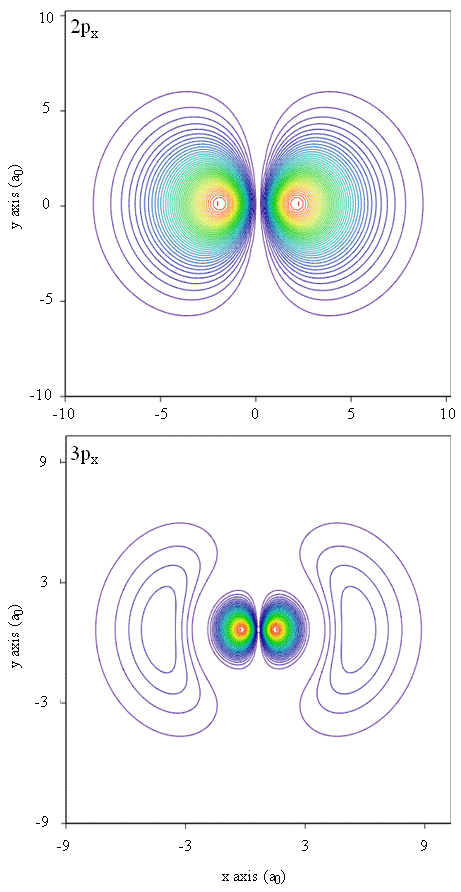
Some other representational technique, virtual reality modeling, holds a great bargain of promise for representation of electron densities. Imagine, for instance, existence able to experience electron density as a force or resistance on a wand that yous motion through three-dimensional space. Devices such every bit these, chosen haptic devices, already exist and are existence used to represent scientific data. Similarly, wouldn't it be interesting to "fly" through an atomic orbital and experience changes in electron density every bit color changes or cloudiness changes? Specially designed rooms with 3D screens and "smart" glasses that provide feedback about the direction of the viewer'due south gaze are currently existence adult to allow us to experience such sensations.
Methods for separately examining the radial portions of atomic orbitals provide useful information about the distribution of charge density within the orbitals. Graphs of the radial functions, \(R(r)\), for the 1s, 2s, and 2p orbitals plotted in Effigy \(\PageIndex{2}\).
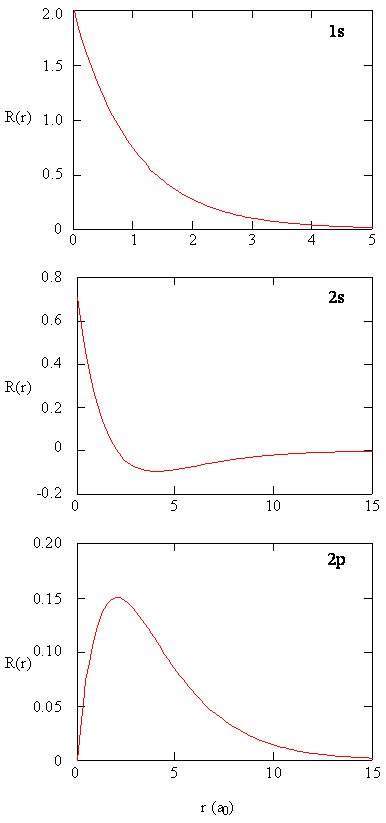
The 1s function in Figure \(\PageIndex{2}\) starts with a high positive value at the nucleus and exponentially decays to essentially zero after 5 Bohr radii. The high value at the nucleus may be surprising, merely as we shall see later, the probability of finding an electron at the nucleus is vanishingly small-scale.
Next notice how the radial role for the 2s orbital, Figure \(\PageIndex{2}\), goes to zilch and becomes negative. This behavior reveals the presence of a radial node in the function. A radial node occurs when the radial function equals nil other than at \(r = 0\) or \(r = ∞\). Nodes and limiting behaviors of diminutive orbital functions are both useful in identifying which orbital is being described by which wavefunction. For example, all of the south functions have non-zero wavefunction values at \(r = 0\), but p, d, f and all other functions go to zero at the origin. It is useful to call up that in that location are \(n-ane-l\) radial nodes in a wavefunction, which means that a 1s orbital has no radial nodes, a 2s has ane radial node, and then on.
Practice \(\PageIndex{5}\)
Examine the mathematical forms of the radial wavefunctions. What feature in the functions causes some of them to go to zero at the origin while the s functions exercise not become to zero at the origin?
Practice \(\PageIndex{6}\)
What mathematical characteristic of each of the radial functions controls the number of radial nodes?
Exercise \(\PageIndex{7}\)
At what value of r does the 2s radial node occur?
Exercise \(\PageIndex{8}\)
Make a table that provides the energy, number of radial nodes, and the number of angular nodes and full number of nodes for each function with north = i, 2, and 3. Identify the relationship between the energy and the number of nodes. Identify the human relationship between the number of radial nodes and the number of angular nodes.
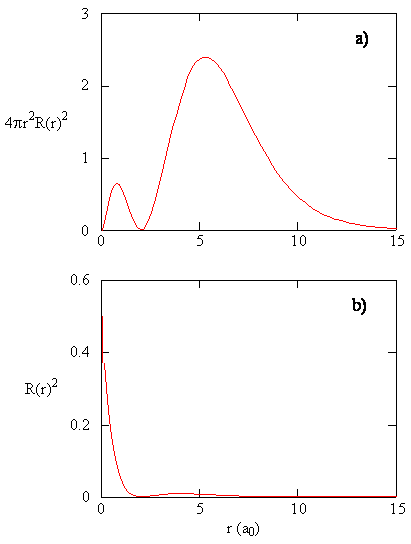
The quantity \(R (r) ^* R(r)\) gives the radial probability density; i.e., the probability density for the electron to be at a point located the altitude \(r\) from the proton. Radial probability densities for three types of atomic orbitals are plotted in Figure (\PageIndex{iii}\).
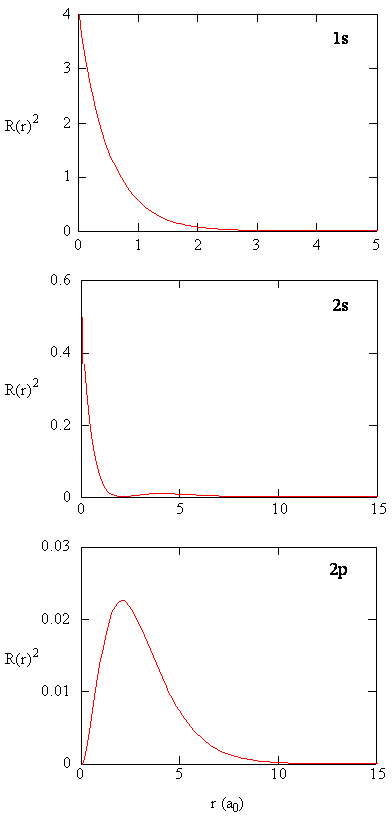
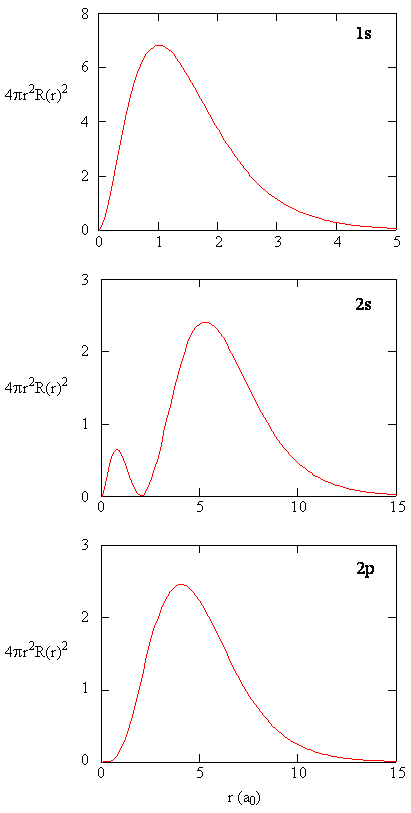
When the radial probability density for every value of r is multiplied by the area of the spherical surface represented past that particular value of r, we get the radial distribution part. The radial distribution role gives the probability density for an electron to be found anywhere on the surface of a sphere located a distance r from the proton. Since the area of a spherical surface is \(4 \pi r^2\), the radial distribution role is given past \(4 \pi r^2 R(r) ^* R(r)\).
Radial distribution functions are shown in Figure \(\PageIndex{4}\). At small values of r, the radial distribution function is low because the small surface surface area for small radii modulates the loftier value of the radial probability density function near the nucleus. As nosotros increase \(r\), the surface area associated with a given value of r increases, and the \(r^ii\) term causes the radial distribution function to increase even though the radial probability density is starting time to decrease. At large values of \(r\), the exponential decay of the radial function outweighs the increase caused past the \(r^2\) term and the radial distribution function decreases.
Exercise \(\PageIndex{9}\)
Write a quality comparison of the radial role and radial distribution office for the 2s orbital. See Figure (\PageIndex{5}\)
Source: https://chem.libretexts.org/Bookshelves/Physical_and_Theoretical_Chemistry_Textbook_Maps/Book:_Quantum_States_of_Atoms_and_Molecules_%28Zielinksi_et_al%29/08:_The_Hydrogen_Atom/8.02:_The_Wavefunctions

Post a Comment for "Easy Way to Remember How Hydrogen Wave Function Density Plots Look"