Pride and Prejudice Jr Paradise Center for the Arts October 6
| 宝塚歌劇団 | |
 Read western style, left-to-right, then top-to-bottom | |
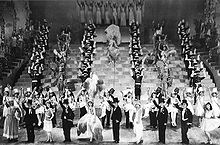 Parisette, 1930 | |
| Formation | 1913 (1913) |
|---|---|
| Type | Theatre grouping |
| Purpose | Musical theatre |
| Location |
|
| Website | kageki |
The Takarazuka Revue (Japanese: 宝塚歌劇団, Hepburn: Takarazuka Kagekidan ) is a Japanese all-female musical theatre troupe based in Takarazuka, Hyōgo Prefecture, Nippon. Women play all roles in lavish, Broadway-mode productions of Western-style musicals and stories adapted from films, novels, shōjo manga, and Japanese folktales. The Takarazuka Revue Company is a sectionalization of the Hankyu Railway company; all members of the troupe are employed by Hankyu.
History [edit]
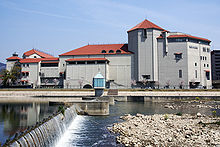
The Takarazuka Revue was founded by Ichizō Kobayashi, an industrialist-turned-politician and president of Hankyu Railways, in Takarazuka, Japan in 1913. The city was the terminus of a Hankyu line from Osaka and already a pop tourist destination because of its hot springs. Kobayashi believed that it was the platonic spot to open an attraction of some kind that would boost train ticket sales and describe more than business to Takarazuka. Since Western song and dance shows were becoming more than popular and Kobayashi considered the kabuki theater to be onetime and elitist,[1] he decided that an all-female person theater grouping might be well received by the general public.
The Revue had its outset functioning in 1914. Ten years later, the company had become popular enough to obtain its ain theater in Takarazuka, called the Dai Gekijō , meaning "Thousand Theater".[two] Today, the company owns and operates another theater, the Takarazuka Theater, in Tokyo.[3] Currently Takarazuka performs for 2.5 million people each year[ citation needed ] and the majority of its fans are women.

The commencement performance Donburako , 1914
Part of the novelty of Takarazuka is that all the parts are played by women, based on the original model of kabuki earlier 1629 when women were banned from the theater in Nippon.[iv] The women who play male parts are referred to every bit otokoyaku ( 男役 , "male person role") and those who play female person parts are called "daughter role"娘役 ( musumeyaku ). Collectively, the Takarazuka performers are chosen "Takarasiennes" ( takarajiennu ). This name derives from the revue's fondness of the French revues.[5]
The costumes, set designs and lighting are lavish, the performances melodramatic. Side pathways extend the already wide proscenium, accommodating elaborate processions and choreography.
Regardless of the era of the musical presented, menses accurateness is relaxed for costumes during extravagant finales which include scores of glittering performers parading downwardly an enormous phase-broad staircase and a Rockette-manner kick line. Lead performers portraying both male and female person roles appear in the finale wearing huge round feathered back-pieces reminiscent of Las Vegas or Paris costuming.
Before becoming a fellow member of the troupe, a young woman must train for 2 years in the Takarazuka Music School, one of the most competitive of its kind in the world. Each year, thousands from all over Japan audition. The twoscore to 50 who are accepted are trained in music, trip the light fantastic, and interim, and are given seven-yr contracts. The school is famous for its strict bailiwick and its custom of having starting time-year students clean the premises each morning.
The start yr, all women railroad train together before being divided by the faculty and the current troupe members into otokoyaku and musumeyaku at the finish of the twelvemonth. Those playing otokoyaku cut their hair short, take on a more than masculine role in the classroom, and speak in the masculine grade.
The company has five main troupes: Blossom ( 花 , hana ), Moon ( 月 , tsuki ), Snow ( 雪 , yuki ), Star ( 星 , hoshi ), and Creation ( 宙 , sora ); equally well every bit an emeritus troupe for senior actresses no longer part of a regular troupe who all the same wish to maintain their association with the revue and perform from time to time. Flower and Moon are the original troupes, founded in 1921. Snow Troupe was founded in 1924 and Star Troupe in 1931, disbanded in 1939, and reestablished in 1948. Cosmos, founded in 1998, is the newest troupe.
Actors [edit]

A musumeyaku is flanked by two otokoyaku , c. 1935.
Though Takarazuka Revue gives the advent of having been created to grant Japanese women liberty from social oppression, ironically, it was created with the opposite intention, with Takarazuka scholar Lorie Brau stating that "The production office and corporate structure that control Takarazuka are overwhelmingly patriarchal."[six] However, although Takarazuka embodies Shiraishi's thought that the actresses become "skillful wives and wise mothers" upon leaving the company, information technology also simultaneously represents progressive feminist points of view. Some believe that its appeal to the female person audience is on account of the perceived link to freedom from traditional Japanese gild's imposed ideas of gender and sexuality. Brau states that while the Takarazuka Revue "reinforces the status quo and sublimates women'southward desires through its dreamy narratives, there remains some possibility that certain spectators observe it empowering but to watch women play men."[6]
Some Takarasienne shows, such every bit The Rose of Versailles and Elisabeth, feature androgynous characters. In Brau's view, the otokoyaku represents the woman'south idealized man, gratis from the roughness or need to boss found in real life. It is these male roles that offering an escape from the strict, gender-bound real roles lauded in Japanese society.[6] In a sense, the otokoyaku provides the female audience with a "dream" of what they want in reality.
In add-on to their claim to "sell dreams", the actresses of the Takarazuka Revue take on another function, empowering themselves as women in a male person-dominated culture. Kobayashi's desire to make his actresses into good wives and mothers has often been hindered by their own will to pursue careers in the entertainment business. It is becoming increasingly more mutual for women to stay in the company well into their thirties, beyond the perceived conventional limits of marriageable age. The actresses' part within the Takarazuka Revue thus overlaps into the culture surrounding information technology, calculation to their appeal to the female-dominant audition. "In fact, it is the conveying over of this 'boyishness' into everyday life and the liberty that this implies that captures the attending of some fans."[six]
The otokoyaku , nevertheless, is not bound to her assigned male person function in the theater. Tsurugi Miyuki, pinnacle otokoyaku star of the Moon Troupe, said that she conceived male person impersonation as just a "role" that she wore like the makeup and costume that helped create her otokoyaku paradigm. She said she reverts to her nonperforming "feminine" self after operation.[6] Other otokoyaku feel uncomfortable switching to female roles. Otokoyaku Matsu Akira, who retired in 1982, stated: "Even though I am a female, the thing called 'female person' just won't sally at all."[7]
Although traditionally an all-female troupe, in 1946 the Takarazuka employed male person performers who were trained separately from the female members of the troupes. Ultimately, however, the female person members opposed these new male counterparts, and the department was dissolved, the last male person department terminating in 1954. A 2007 Japanese musical, Takarazuka Boys, was based on this chapter of the company'south history.
While the casts are all-female, the staff (writers, directors, choreographers, designers, etc.) and orchestra musicians may be male person or female person. Information technology is not uncommon in Takarazuka for a predominantly male orchestra to be led past a female conductor.
Troupes [edit]
The five troupes ( 組 , kumi ) of the Takarazuka Revue take certain differences of fashion and fabric which make each unique.
Flower Troupe ( Hana-gumi ) [edit]
The Flower Troupe is considered the "treasure chest" of otokoyaku . Many of the most popular former and electric current top stars of the company originated in Blossom Troupe; these include Miki Maya (who held the first Budokan solo concert in Takarazuka's history), Sumire Haruno and Tomu Ranju of Blossom, Jun Shibuki, Jun Sena and Kiriya Hiromu of Moon, and Hikaru Asami of Snowfall. Their performances tend to have larger budgets, with lavish stage and costume designs, and are ofttimes derived from operatic material.
Moon Troupe ( Tsuki-gumi ) [edit]
While tending to be a home for immature performers (with Yūki Amami in her sixth twelvemonth reaching the status of top star in the 1990s), the members of Moon Troupe are also strong singers. The term "Musical Inquiry Section" is occasionally used in articles about the troupe, underscoring the troupe's focus on music. Their fabric tends toward drama, Western musicals, and modern settings, such as Guys and Dolls and Me and My Girl. During the era of Makoto Tsubasa every bit top star, they had at least two musicals adopted from archetype western novels.
Snow Troupe ( Yuki-gumi ) [edit]
Snow Troupe is considered the upholder of traditional dance and opera for the whole company, beingness the vanguard of traditional Japanese drama in a company that tends towards Western cloth. They were the first troupe to perform Elisabeth in Japan. The troupe has been moving towards the opera and drama style of Moon and Blossom.
Star Troupe ( Hoshi-gumi ) [edit]
Star Troupe tends to be the habitation of Takarazuka'due south stars. They, along with Flower Troupe, have very strong otokoyaku players. In recent years, many of the company'south prominent musumeyaku take also originated from Star Troupe, such every bit Hana Hizuki, Shizuku Hazakura, and Yuki Aono.
Cosmos Troupe ( Sora-gumi ) [edit]
Cosmos, the newest troupe, is less traditional and more experimental. When it was first formed, it culled talent from the other troupes. The Cosmos mode is influenced past performers like Asato Shizuki, the founding otokoyaku top star; Yōka Wao and Mari Hanafusa, the "Aureate Combi" who headed the troupe for vi of its beginning eight years. Cosmos were the first troupe to perform Phantom and to have a Broadway composer (Frank Wildhorn) write their musical score. Almost of the otokoyaku in this troupe are in a higher place 170 centimetres (5.6 ft) tall (the nigh notable is Hiro Yuumi, the tallest in the company since she joined in 1997 until her retirement in 2013). While information technology had a troupe-born actress go musumeyaku top back in 2006 with Asuka Toono, it was not until 2022 that an actress originating from this troupe became an otokoyaku pinnacle star: Seina Sagiri, the quondam top star of Snow Troupe (2014–2017).
Types of musicals performed [edit]
Adaptations of Western works [edit]
While the majority of Takarazuka works are written "in business firm" by members of the artistic staff, they are oftentimes adapted from Western classic musicals, operas, plays, novels or films:
Adaptations of Japanese works [edit]

Stories based in Nippon and modeled on historical accounts or traditional tales, are ofttimes referred to as nihonmono ( 日本物 ) or, less frequently, wamono ( 和物 ). Among the almost mutual of these adjusted to the Takarazuka stage is The Tale of Genji.
Popular manga series have ofttimes shaped Takarazuka, such every bit in the case of Riyoko Ikeda's The Rose of Versailles. Other manga adaptations include The Window of Orpheus, also by Ikeda, Osamu Tezuka's Black Jack and Phoenix, and Yasuko Aoike's El Halcón.
Recent[ timeframe? ] examples of works adapted from Japanese novels or curt stories include Moon Troupe's Osaka Samurai ( 大阪侍 ), based upon the short story by Ryōtarō Shiba, and Flower Troupe's Black Lizard ( 黒蜥蜴 , Kurotokage ), based upon the Kogoro Akechi story by Edogawa Rampo.
In 2009, Takarazuka Revue performed ii shows based on an adaptation of Capcom's video game serial Phoenix Wright.[12] They took the stage in January 2013 to represent the courtroom game once again with the production titled Prosecutor Miles Edgeworth: Ace Chaser iii.[13] In June 2013, the Revue would debut at Tokyo'southward Tokyu Theatre Orb an adaptation of some other Capcom video game, Sengoku Basara ,[14] done by the Flower Troupe. This focused on character Yukimura Sanada, played past Tomu Ranju, the same extra who had taken the function of Phoenix Wright prior to becoming a peak star.
In 2017, the Flower Troupe performed a stage adaptation of the shōjo (girls') manga series Haikara-San: Here Comes Miss Mod,[fifteen] and performed it over again in 2020.[16] In 2019, the Blossom Troupe also performed a stage adaptation of the shōjo manga series Boys Over Flowers.[17] In August 2022, the Cosmos Troupe are gear up to perform a phase accommodation of the series Loftier & Depression[xviii] in collaboration with LDH.
Adaptations of other Asian works [edit]

Among works adapted from other Asian sources is the Beijing opera The Hegemon-King Bids His Concubine Farewell, detailing the romance betwixt General Xiang Yu and his lover Madam Yu.
Original stories and historical adaptations [edit]
Musicals have likewise been performed throughout the years based upon people and events in American, European, and Asian history. Among the more recognizable of these biographical adaptations are Last Party: S. Fitzgerald's Last Day, most F. Scott Fitzgerald; Valentino, about Rudolph Valentino; Dean, about James Dean; and Saint-Exupéry: The Airplane pilot Who Became "The Niggling Prince", about Antoine de Saint-Exupéry.
Finally, original stories round out Takarazuka fare, including musicals such equally Boxman past Cosmos Troupe, Too Short a Time to Fall in Love performed by Star and Moon Troupes, and Silver Wolf by Moon and Snow Troupes.
Collaborations [edit]
Takarazuka has occasionally worked with notable writers, composers, and choreographers to create original content for the revue. In 1993, Tommy Melody wrote, directed and choreographed the revue Broadway Boys to accompany Moon Troupe's rendition of Thousand Hotel. In 2006, Takarazuka worked with Frank Wildhorn, musical writer and composer of Jekyll & Hyde and The Scarlet Pimpernel, to create Never Say Goodbye for Cosmos Troupe. In 2019, Takarazuka worked with Pigeon Attia, music producer of 1789: Les Amants de la Bastille and La Légende du roi Arthur , to etch Casanova for Bloom Troupe.
Personnel [edit]
Star personnel [edit]
The current top stars of each group are:[19]
| Group | Otokoyaku | Musumeyaku |
|---|---|---|
| Senka | Yū Todoroki[1] | |
| Blossom | Rei Yuzuka | Madoka Hoshikaze |
| Moon | Kanato Tsukishiro | Mitsuki Umino |
| Snow | Sakina Ayakaze | Kiwa Asazuki |
| Star | Makoto Rei | Hitomi Maisora |
| Creation | Suzuho Makaze | Hana Jun |
^ The youngest member to ever serve on the board of directors
Other primary performers in the company [edit]
| Group | Flower | Moon | Snow | Star | Cosmos |
|---|---|---|---|---|---|
| Otokoyaku | Maito Minami, Body of water Towaki, Asuka Seino | An Houzuki, Chisei Akatsuki, Yuno Kazama | Jun Asami, Sora Kazuki, Ouka Aya | Yuria Seo, Ema Amahana, Shin Kiwami | Toa Serika, Minato Sakuragi, Hikaru Rukaze |
| Musumeyaku | Kurisu Oto | Michiru Irodori, Juri Amashi, Karen Yui, Haryuu Kiyora | Himari Nonoka, Aya Yumeshiro | Minori Otoha, Hitomi Arisa, Kozakura Honoka | Mineri Amairo |
Seniority [edit]
The gender-neutral terms senpai (upperclassmen) and kōhai (lowerclassmen) are used to distinguish senior and junior members of Takarazuka. Lowerclassmen are the actresses who accept been performers in Takarazuka for less than seven years. They are employees of the company, and commonly piece of work every bit background dancers and in shinjin kōen (performances exclusively for underclassmen). After the seventh yr they become upperclassmen, and negotiate contracts with the company instead of being employed past it.
Sometime Takarasiennes [edit]
Takarazuka roster members who went on to piece of work in stage, movies, and television set include:
| Otokoyaku | Musumeyaku |
|---|---|
|
|
Audience [edit]
Women make up the primary audience of Takarazuka; in fact, some estimates say the audience is 90 percentage female.[half dozen] There exist ii primary theories as to what draws these women to Takarazuka. These theories, put frontward by Western scholars, complement each other, cartoon on the traditional homoerotic elements of Japanese performing arts, and the ancient subversive nature of the feminine in Japan. One is that the women are drawn to its inherent lesbian overtones. One author states, "Information technology was not masculine sexuality which attracted the Japanese girl audience only information technology was feminine eroticism".[20] Another theory is that the girls are not fatigued to the implicit sexuality of Takarazuka, but instead are fascinated by the otokoyaku (the women who play male person roles) "getting away with a male operation of power and freedom".[21]
Favoring the first theory, American Jennifer Robertson[22] observes that lesbian themes occur in every Takarazuka performance, just by virtue of the fact that women play every role. The audience clearly picks up on it and responds. Within the first ten years of Takarazuka's founding, the audience was vocally responding to the apparent lesbianism. Female fans wrote love messages to the otokoyaku . In 1921 these letters were published and several years later on newspapers and the public rallied a cry against Takarazuka, claiming it was apace becoming a "symbol of aberrant love". In club to combat this, the producers kept its actresses in strict living weather; they were no longer immune to acquaintance with their fans.[23] Robertson mentions a miracle of "S" or "Class S" dear, a particular style of dear wherein women who take been influenced by Takarazuka return to their daily lives feeling free to develop crushes on their female person classmates or coworkers.[ citation needed ] This type of romance is typically fleeting and is seen in Japanese society as more of a stage in growing up rather than "true" homosexuality.[20] Robertson sums up her theory thus: "Many [women] are attracted to the Takarazuka otokoyaku because she represents an exemplary female who can negotiate successfully both genders and their bellboy roles and domains."[23]
The other theory, supported by Canadian Erica Abbitt,[24] is that the female audience of Takarazuka is drawn not exclusively by lesbian overtones, but rather by the subversion of stereotypical gender roles. Japan is a society notorious for its rigid conception of gender roles. While the original goal of the show may have been to create the ideal practiced wife and wise female parent off phase, on-stage gender roles are, by necessity, subverted. The otokoyaku must act the fashion men are supposed to act. Abbitt insists that a large portion of the appeal of Takarazuka comes from something she calls "slippage", referring to the enjoyment derived from a character portraying something they are not, in this case a adult female portraying a man. While non denying the presence of lesbian overtones inside Takarazuka, Abbitt proposes the cause for the largely female person audience has more to practice with this subversion of societal norms than sexual ones.[21] In essence, the role of otokoyaku presents a type of androgynous freedom that embraces slippage and a non-constrained continuum of gender.[25] While the actual female otokoyaku performer's masculine persona or "secondary gender" was disapproved of exterior of the theatrical purposes of Takarazuka, female person fans were able to embrace the total gender-fluid continuum otokoyaku provided, too as engage with Takarazuka in the context of a gender-sexual practice political discourse.[five]
Fan clubs [edit]
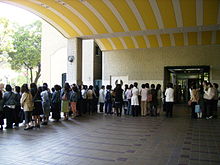
Some fans demonstrate their loyalty to a detail performer by joining her fan lodge. Club members can be identified by their wearing scarves of a particular color or even jackets colorfully embroidered with the star's name. Following performances at the Takarazuka Grand Theatre or Tokyo Takarazuka Theatre, as many every bit several hundred fans congregate in their various gild groups and stand in orderly ranks on either side of the street in front end of the theatre. The clubs are arranged past actress seniority inside the troupe. Theatre officials set upwards barricades and oversee the associates.
Whenever an actress exits the theatre, the frontmost group volition sit and all the others follow suit (much like the "wave" seen in athletic arenas) with subsequent intervals of standing and sitting. The fans await patiently, with little conversation, for their favorites to exit the theatre.[26] An almost eerie ritualistic calm prevails. As the stars come out of the edifice ane by one, some solitary merely most accompanied by staff members of their gild, orderly quiet continues to prevail. The glamorous performers, at present more often than not in slacks or jeans with high heels and wearing oversize visored "newsboy" caps to hide their hair (and some with sunglasses even at night), move along to their own particular fan clubs. Rather than requesting autographs, the fans proffer cards, which are gathered efficiently by each star, who may say a few words only and then waves and moves on. Once the last stars accept emerged and departed, the clubs disband quietly.
Influence [edit]
Takarazuka has had a profound influence on the history of anime and manga, especially shōjo manga.[27] [28] Osamu Tezuka, a highly influential manga creator, grew up in the town of Takarazuka. His mother knew many of the Takarazuka actresses, and as a child he knew them and watched many of their performances.[27] [29] Based on their stories of noble princes played by female actresses,[27] Tezuka created Princess Knight,[xxx] the first manga aimed at a female audience, which tells the story of Princess Sapphire, a girl born with both a male and female heart who struggles between the desire to fight as a noble prince and to be a tender, gentle princess. The great success of Princess Knight and other Tezuka stories began the tradition of manga written for a female audience, especially the very influential The Rose of Versailles and Revolutionary Girl Utena serial, both of which borrow directly from Princess Knight past including specific Tezuka images, character designs and names. The Rose of Versailles is one of Takarazuka's best-known musicals. Women in masculine roles continue to be a central theme in shōjo manga and anime, too every bit in some shōnen (boys') series, and Tezuka himself explored the theme in many of his subsequently works, including Dororo , Phoenix and Blackness Jack .
While the influence of Osamu Tezuka and Takarazuka on anime and manga is general, there are withal many series which evidence more than specific influences. The Takarazuka Revue inspired the plot of the original Sakura Wars video game, forth with additional inspiration from Takarazuka's 1-fourth dimension competitor the Shochiku Kagekidan (Shochiku Revue).[31]
The Zuka Social club in Ouran High Schoolhouse Host Club is based on the Takarazuka Revue.[ citation needed ]
The lesbian characters Haruka Tenou and Michiru Kaiou of Sailor Moon were loosely based on the actors of the Takarazuka Revue.[32]
The Virgin'south Mask by Jūrō Kara, a meaning work of mail service-state of war theater, features an aging " Zuka -daughter" attempting to repossess her youth through ritualistic bathing in a tub of virgins' tears.
The musical anime series Revue Starlight has elements based on the troupe, including uniforms, the school seal, and theater style, and makes utilise of these elements to present a critique of Takarazuka practices, particularly the Top Star arrangement.[33]
The Tokyo theater group Kegawa Zoku ("Fur Tribe") has produced homosexual parodies of archetype Takarazuka shows like Gone with the Wind.[34]
The manga and anime series Kageki Shojo!! follows two teenage girls enrolled in a fictional version of the Takarazuka Music School. There, they train in singing, interim, and dancing, in hopes of joining the infamous all-female theatre troupe. I of the girls, Sarasa, dreams of playing Oscar François de Jarjayes in the theatre's product of Rose of Versailles.[35]
The ane episode of the anime series Stop!! Hibari-kun! features Wataru Otori, an eccentric drag rex who takes on the role of Rhett Butler for the Gone with the Current of air play.[ citation needed ]
Takarazuka and homosexuality in Japanese gild [edit]
After the scandal of women writing beloved letters to the otokoyaku and the revelation of an bodily lesbian relationship between a otokoyaku and a musumeyaku ,[ when? ] the revue greatly limited itself in order to do away with the lesbian image. Women wore militaristic uniforms, heightening the allure even more amongst some audience goers. There was another scandal in 1932 when, for the showtime time, one of the otokoyaku cut her pilus short (previously all of the actresses had their hair long and the otokoyaku simply hid their hair under hats).[36] In August 1940, the actresses were even forbidden to reply fan mail and socialize with their admirers.[23] [ folio needed ] In the years since and then, the regulations have relaxed but not by much.
Legacy [edit]
In the 1957 film Sayonara, set largely in neighboring Kobe, the all-female "Matsubayashi" theater troupe bears many similarities to the Takarazuka Revue.
A 1996 blackness-and-white photograph of a Takarasienne, taken past Daido Moriyama, appeared on the October 1999 cover of Art in America.[37]
Run into as well [edit]
- Films from Takarazuka Revue produced by Takarazuka Eiga
- Breeches part
- Cross-dressing
- Elevate (clothing)
References [edit]
- ^ Kobayashi Ichizo. "Takarazuka Manpitsu (1955)". Tokyo, Daiyamondsha. 1961. Kobayashi Ichizo 2: 445-46.
- ^ Kawatake, Toshio. "A History of Japanese Theater II: Bunraku and Kabuki". Kokusai Bunka Shinkokai. Tokyo. 1971. pp. 15–52.
- ^ Takahara, Kanako, "Fans make troupe phenomenon it is", The Japan Times, 23 June 2009, p. iii.
- ^ Leupp, Gary P. Male Colors: The Construction of Homosexuality in Tokugawa Japan. University of California Press, 1997. ISBN 0-520-20900-1.
- ^ a b Robertson, Jennifer (August 1992). "the politics of androgyny in Japan: sexuality and subversion in the theater and beyond". American Ethnologist. 19 (3): 419–442. doi:10.1525/ae.1992.xix.3.02a00010. hdl:2027.42/136411.
- ^ a b c d eastward f Lorie Brau. ""The Women's Theatre of Takarazuka." TDR 34.4 :79-95.
- ^ Robertson, Jennifer (1989). "Gender-Bending in Paradise: Doing 'Female' and 'Male' in Japan". Genders. 5: l–69. ISSN 0894-9832.
- ^ 木原敏江「アンジェリク」新装版が「星降草子」と同時発売 [New edition of Toshie Kihara'due south Angélique released at the same fourth dimension as Hoshifuru Sōshi]. Comic Natalie (in Japanese). 16 May 2014. Retrieved 17 February 2021.
- ^ 木原 敏江 [Toshie Kihara]. Mangapedia (in Japanese). Heibonsha, Shogakukan, et al. Retrieved 17 Feb 2021.
- ^ The Takarazuka Concise Madame Butterfly, tr. by K. and L. Selden, introduced by Arthur Groos in Japan Focus fourteen, fourteen, 7 (July 2016).
- ^ ミュージカル『アーサー王伝説』 [Musical: Legend of King Arthur]. Official Takarazuka Revue (in Japanese). Retrieved 6 April 2017.
- ^ 株式会社カプコン:ゲーム:逆転裁判シリーズ:タイトルラインナップ. Capcom.co.jp . Retrieved 9 March 2015.
- ^ "Takarazuka Revue Will Present Third Prove in the Ace Attorney Series". Capcom.co.jp . Retrieved 9 March 2015.
- ^ "Capcom and Takarazuka Revue Will Present the Get-go Musical Based on the Sengoku BASARA Series - First production by the Takarazuka Flower Troupe based on a game is expected to further raise the value of Capcom content". Capcom.co.jp . Retrieved 9 March 2015.
- ^ Hodgkins, Crystalyn (14 April 2017). "Haikara-san ga Tōru Manga Gets Musical by Takarazuka Revue". Anime News Network . Retrieved 17 February 2021.
- ^ ミュージカル「はいからさんが通る」再演決定、花組新トップ柚香&華のお披露目公演. Comic Natalie (in Japanese). 29 July 2019. Retrieved 17 Feb 2021.
- ^ Hodgkins, Crystalyn (11 Jan 2019). "Boys Over Flowers Manga Gets Musical by Takarazuka Revue'due south Flower Troupe". Anime News Network . Retrieved 17 February 2021.
- ^ HiGH&Depression×宝塚歌劇!SWORD誕生前夜のコブラの悲恋描く宙組公演. Music Natalie (in Japanese). 24 Dec 2021. Retrieved 28 February 2022.
- ^ https://kageki.hankyu.co.jp/english/troupe/alphabetize.html
- ^ a b Dollase, Hiromi (2003). "Early on Twentieth Century Japanese Girls' Mag Stories: Examining Shōjo Voice in Hanamonogatari (Bloom Tales)". The Journal of Popular Culture. 36 (4): 724–755. doi:10.1111/1540-5931.00043. OCLC 1754751.
- ^ a b Abbitt, Erica Stevens. "Androgyny and Otherness: Exploring the West Through the Japanese Performative Trunk". Asian Theatre Journal eighteen.2: 249-256.
- ^ "Jennifer Robertson". umich.edu . Retrieved 9 March 2015.
- ^ a b c Robertson, Jennifer. "Takarazuka: Sexual Politics and Popular Civilisation in Modern Japan." Berkeley: Academy of California Press, 1998.
- ^ "Prof. Erica Abbitt's webpage at the Academy of Windsor, Canada". uwindsor.ca . Retrieved 9 March 2015.
- ^ Abbitt, Erica Stevens (2001). "Androgyny and Otherness: Exploring the West Through the Japanese Performative Torso". Asian Theatre Journal. 18 (2): 249–256. doi:10.1353/atj.2001.0012. ISSN 1527-2109. S2CID 162239691.
- ^ "The feminine 'kabuki' culling". taipeitimes.com. eleven June 2006. Retrieved 9 March 2015.
- ^ a b c Randall, Bill (15 May 2003). "3 By Moto Hagio". The Comics Journal (252). Retrieved 23 January 2008.
- ^ Anan, Nobuko (2016). Contemporary Japanese Women's Theatre and Visual Arts. London: Palgrave Macmillan UK. doi:10.1057/9781137372987. ISBN9781349557066.
- ^ Gravett, Paul (2004). Manga: lx Years of Japanese Comics. Harper Pattern. p. 77. ISBNone-85669-391-0.
- ^ Welker, James (2006). "Cute, Borrowed, and Bent: 'Boys' Love' equally Girls' Love in Shōjo Manga". Signs: Journal of Women in Culture and Society. 31 (three): 841. doi:10.1086/498987. S2CID 144888475.
- ^ Interview with Ouji Hiroi, partially translated at the Takarazuka Revue Community LiveJournal page Archived 5 February 2008 at the Wayback Machine. With regards to Sakura Wars, non only did the Kagekidan inspire the plot for the serial, information technology also strongly influenced the organization of the characters, namely the Hanagumi . Retrieved on 19 July 2007
- ^ Takeuchi, Naoko (October 1, 1999). Materials Drove. Translated by Alex Glover. Nihon: Kodansha. Retrieved 10 Oct 2006.
[Haruka] plays a male role in Takarazuka.
- ^ "Series Finale: Revue Starlight ‒ Episode 12". Anime News Network . Retrieved 31 March 2019.
- ^ Anan, Nobuko (2011). "2-Dimensional Imagination in Gimmicky Japanese Women's Performance" (PDF). TDR/The Drama Review. 55 (4): 96–112. doi:x.1162/DRAM_a_00125. ISSN 1054-2043. S2CID 55532655.
- ^ Moore, Caitlin (24 November 2020). "Review: Kageki Shoujo!! The Mantle Rises". Anime News Network . Retrieved 18 February 2021.
- ^ Robertson 1998, p. 13.
- ^ Cover entitled "Osaka," Fine art in America, Oct 1999.
General references [edit]
- Robertson, Jennifer Ellen (1998). Takarazuka: Sexual Politics and Popular Culture in Modern Nippon. Berkeley and Los Angeles, Calif.: University of California Press. p. 50. ISBN0-520-21150-2.
- The Politics of Androgyny in Japan: Sexuality and Subversion in the Theater and Across Jennifer Robertson American Ethnologist, Vol. xix, No. three (Aug., 1992), pp. 419-442.
Further reading [edit]
- Leonie R. Stickland, Gender Gymnastics: Performing and Consuming Japan's Takarazuka Revue, Melbourne, Australia: Trans Pacific Printing, 2008 Review of Gender Gymnastics
- Makiko Yamanashi, A History of the Takarazuka Revue Since 1914. Modernity, Girls' Culture, Japan Pop, Leiden: Global Oriental & Brill, 2012 Review of A History of the Takarazuka
- James Roberson and Nobue Suzuki, Men and Masculinities in Contemporary Nippon: Beyond the Salaryman Doxa, London and New York: Routledge Curzon, 2003
- Alisa Roost. "Elisabeth". Theatre Journal. Vol sixty.two.
- "Japanese tradition meets Western musicals"—Article on the Takarazuka Revue from the travel section of The Christian Science Monitor (20 Apr 2005).
- "Welcome to Romance Theatre", by M. Avila, Jade Magazine, March 2004.
- Anan, Nobuko (2016). Contemporary Japanese Women's Theatre and Visual Arts. London: Palgrave Macmillan United kingdom of great britain and northern ireland.
- "A Century of Dreams and Romance: A History of Japan's All-Female person Takarazuka Revue". Nippon.com. 4 June 2014. Retrieved 17 February 2021.
- "A History of Takarazuka Revue Influences in Anime". Anime News Network. 15 September 2021. Retrieved xv September 2021.
External links [edit]
- Official website: Japanese version, English language version
- The Takarazuka Revue—A 1996 article originally published in Polare magazine
- The Takarazuka Concise Madame Butterfly, tr. by K. and 50. Selden, introduced by A. Groos in Japan Focus 14, 14, 7 (July 2016)
Coordinates: 34°48′26″Due north 135°20′47″E / 34.80722°N 135.34639°East / 34.80722; 135.34639
Source: https://en.wikipedia.org/wiki/Takarazuka_Revue

Post a Comment for "Pride and Prejudice Jr Paradise Center for the Arts October 6"