What You Need to Know About the Medea

Probably no other aboriginal play has been produced in modern times equally often as Medea. Although it only won third place when it was first performed, information technology shortly became popular, and was one of a set of 10 plays by Euripides that were widely known from antiquity through the Centre Ages.
The Athenian audition who attended the festival of Dionysos to see Euripides's Medea in 431 B.C. was well versed in the legends of Jason and Medea–they wanted to encounter what the bang-up Euripides would make of them. And he did not disappoint: Medea'southward killing of her children and her escape in the chariot of the sun were evidently invented past the poet himself, his personal contribution to epic fable.
The play Mojada: A Medea in Los Angeles, existence performed at the Getty Villa this autumn, is the latest in a series of modern productions and adaptations of the story. Playwright Luis Alfaro moves Euripides' ancient story to present-day East L.A., changing settings and names but keeping the essence of its characters intact. To sympathize Mojada, it helps to have a grasp of the story's ancient roots.
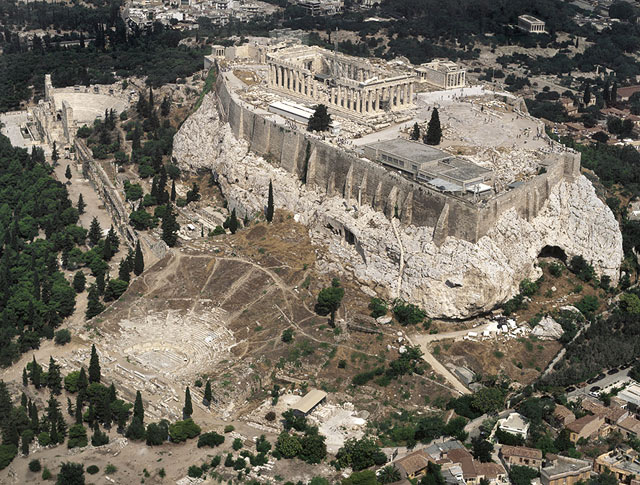
Euripides' plays were performed in the vast theater of Dionysos, shown in the foreground in this view of the Acropolis. Photograph © and courtesy of Hans Rupprecht Goette
Backstory: The Myth of Jason and Medea
The legendary adventures of Jason and Medea course the backstory to the activeness in Medea and Mojada. Ancient Greek theatergoers would have known the tales well.
Jason is heir to the throne of the Greek kingdom of Iolcus. After his uncle Pelias usurps his father's place, Jason spends his childhood hidden on Mt. Pelion, raised past the centaur Cheiron (the tutor of Achilles).
When Jason comes of age, Pelias promises to return the throne to him—if he tin consummate a number of overwhelming tasks. One of these is to detect the Gilt Fleece and bring information technology abode to Thessaly. The fleece is kept by rex Aeëtes at the eastern cease of the Black Ocean at Colchis, where information technology is hung in an oak tree and guarded by a barbarous dragon. To make the journey Jason builds a potent ship, which he names the Argo, and mans information technology with a crew of Greek heroes, legendarily known as the Argonauts.
To clinch Jason'south success, his protectress Hera causes the sorceress princess Medea, Aeëtes'southward girl, to fall in love with him. Backed by Medea'southward powers, Jason is able to yolk two fire-breathing bulls, plough the field of Ares, and sow it with dragon's teeth. He likewise overcomes the dragon itself and collects the Golden Fleece.
Faithfully promised to one some other (Euripides is not clear on their married land), Jason and Medea set out for Iolkos to claim Jason'southward heritage. They are angrily pursued by her family, who seek to reclaim the Fleece, their most precious possession, and exact revenge for her betrayal. In the ensuing conflict Medea kills her own brother, Apsyrtus, throwing chunks of his body into the sea to distract the mourning Aeëtes, who slows to gather up the pieces of his murdered son.
When Jason and Medea get in in Iolkos, they find the aging Pelias unwilling to yield the throne. His daughters, nevertheless, are concerned most his historic period and seek Medea's help to rejuvenate him. As a show of her powers Medea cuts up a ram, throws the pieces in a boiling cauldron, and brings it back to life.
This convincing example serves Medea's cause well, and the women cut upwards their male parent to eddy him into youth. This time, though, Medea withholds her magic, leaving Pelias dead. But instead of finally attaining the throne, the murderous duo is exiled together with their two sons. They flee to Corinth, where Euripides opens the adjacent affiliate.
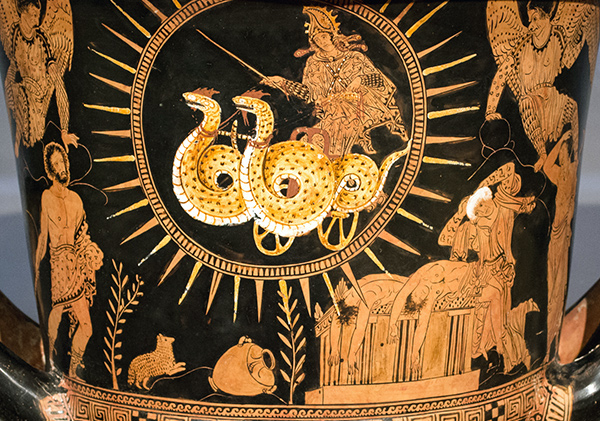
Mixing Vessel with Medea Departing in a Chariot (detail), nearly 400 B.C., attributed to the Policoro Painter. Terracotta, 19 7/8 ten 19 5/8 in. The Cleveland Museum of Art, Cleveland, Ohio, Leonard C. Hanna Jr. Fund, 1991.1. Photo: Tim Evanson on Flickr, CC By-SA 2.0
The Plot of Euripides' Medea
The play opens at a fateful moment. Medea, deranged and vengeful, has only learned that Jason intends to ally the princess of Corinth. She laments off-stage while the nurse sets up the story with grave business organization, fearful for the future of the boys in the face of their mother'southward need for revenge. The Chorus of local women arrive and Medea appears, persuading them to remain quiet about any plans she might make. Creon enters, banishing her from Corinth immediately, but Medea persuades him to give her just one more twenty-four hour period.
Jason arrives and, in the confront of Medea's accusations, attempts to convince her that this spousal relationship is best for their family. Aegeus, the rex of Athens, visits Medea and promises to provide her refuge if she volition help him over his childlessness. Her escape assured, Medea decides that killing her children is the but way to properly punish Jason for his betrayal. She pretends to brand peace with Jason and sends the boys to the palace with a gift for his new bride: a gown and tiara soaked in poison.
Later on wrestling with her censor, Medea steels herself to the act of killing her children, whose death cries tin can soon be heard off stage. Jason returns to the house, in daze from the disaster at the palace, simply to discover a greater tragedy at home. Medea appears above the orchestra like a god (deus ex automobile) in the dragon chariot of the sun, holding the two dead boys in her arms. Despite Jason's drastic pleas, Medea escapes with their corpses, eliminating Jason's progeny forever.
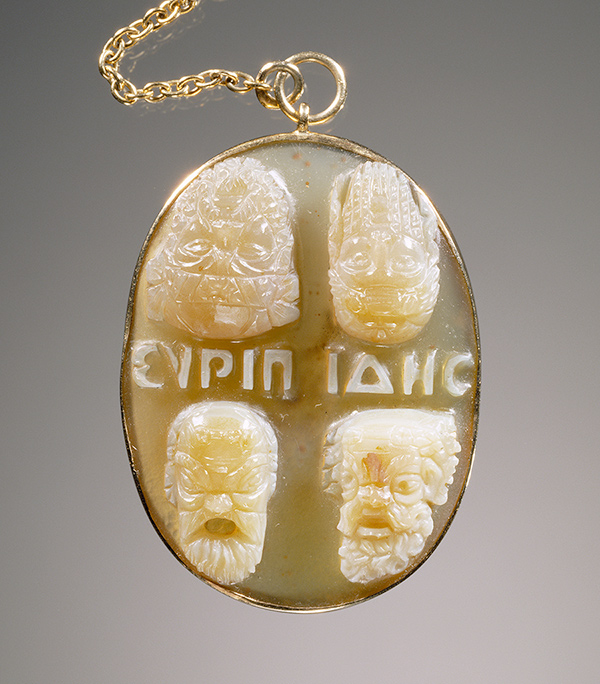
Cameo with 4 masks engraved in Greek with the proper name "Euripides," A.D. 1–100, Roman. Sardonyx, 1 i/8 in. high. The J. Paul Getty Museum, 2001.28.7
Reinventing Medea
Euripides was 1 of many poets of the 5th century B.C. whose work sprang from the ancient Homeric epic poetic tradition. His plays, in plow, inspired Hellenistic poets of the fourth and third centuries B.C., including Apollonius Rhodius, writer of the epic verse form of Jason and the Argonauts known as the Argonautica. In the global Mediterranean of the Hellenistic era, Athens was replaced as the center of literary creativity by Alexandria, Arab republic of egypt, where the Museum (the Shrine of the Muses) held an amazing quantity of Greek literature in its famous library. Although most of what Apollonius read was lost in the tragic burning of the library, the surviving xix plays of Euripides (out of 92) continue to inspire today's playwrights.
Continuing the tradition and mirroring the original Greek text, in Mojada Luis Alfaro has written a play inspired by the metropolis of Los Angeles, a city of cities, a global urban center of hundreds of languages, a city of immigrants. Taking his lead from Euripides while firmly rooted in the culture of Los Angeles, Alfaro recognizes in the ancient story of Medea and Jason a contemporary narrative of immigrant foreigners in a global society. Alfaro's interests parallel those of Euripides: experimentation with traditional narratives, the creation of psychologically complex characters, the humanization of heroes, and the crucial significance of family and lineage.
What You Need to Know About the Medea
Source: https://blogs.getty.edu/iris/a-guide-to-euripides-medea/

Post a Comment for "What You Need to Know About the Medea"